RAG vs. Fine-Tuning: A Cost and Architecture Decision Framework for Enterprise AI
A practical comparison of RAG and fine-tuning, covering costs, architecture, scalability, and key factors to help enterprises choose the right AI approach.
Seasia Infotech
Verified Agency Contributor
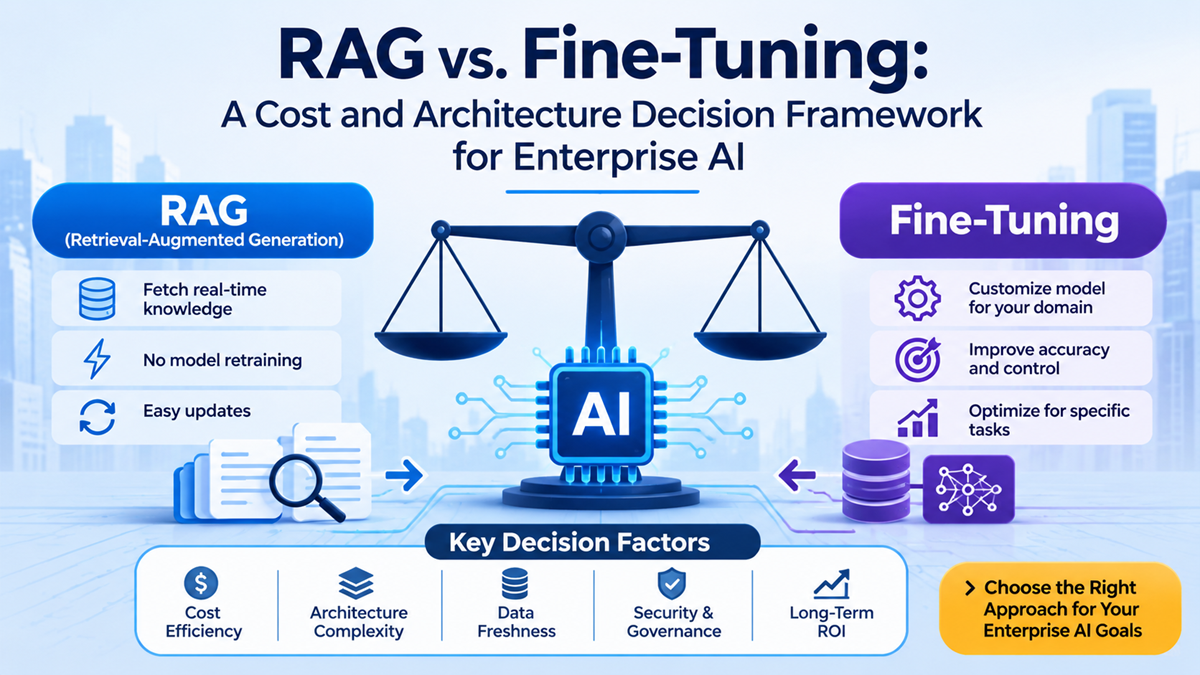
An enterprise AI project can perform well during a demonstration and still become expensive or unreliable after deployment. The problem often lies in how the application handles company information and model behaviour. A customer support assistant, for instance, may need access to changing product records, while a document-processing system may need to follow a specialised reporting format. These requirements call for different engineering decisions. Choosing between RAG vs fine-tuning - retrieval versus model training, or a combination of both - requires an understanding of the workload, data lifecycle, and long-term operating costs.
RAG and Fine-Tuning Solve Different Problems
The distinction between Retrieval-Augmented Generation vs Fine-Tuning becomes clearer when the two approaches are examined through their impact on an application's data and model behaviour.
RAG - Keeping Enterprise Knowledge Accessible
Retrieval-Augmented Generation connects an LLM to external information sources. Rather than relying entirely on knowledge acquired during training, the application searches relevant documents when a user submits a request. The retrieved information is then supplied to the model as context for generating an answer.
Consider an organization with thousands of employees accessing an internal assistant for HR policies, reimbursement procedures, and compliance documents. These records change regularly. A retrieval-based system allows the organization to update its document index without retraining the underlying model.
However, building RAG involves more than connecting a vector database to an LLM. Engineering teams must manage-
- Document ingestion- Extracting usable information from PDFs, databases, internal portals, and other sources.
- Chunking and embeddings- Breaking documents into searchable sections and converting them into numerical representations.
- Retrieval quality- Selecting appropriate search methods, metadata filters, and reranking strategies.
- Access permissions- Ensuring employees only retrieve information they are authorised to view.
- Index maintenance- Removing outdated records and refreshing embeddings when source information changes.
A poorly maintained index can return conflicting policy versions or irrelevant passages. The model may then produce a convincing answer based on incorrect context. This is why retrieval evaluation and document governance need attention before production deployment.
Fine-Tuning - Improving Model Behaviour
Fine-tuning addresses a different requirement. It adapts a pre-trained model using examples of the responses or task outputs an organisation expects.
For example, an insurance company may process thousands of claims requiring classification into predefined categories. Its model needs to recognise specialised terminology and return consistent structured outputs. Fine-tuning can help improve performance on this repeated task.
Parameter-efficient methods such as Low-Rank Adaptation (LoRA) make training more accessible by updating a smaller set of parameters rather than the entire model.
The limitation is knowledge freshness. A model trained on an earlier set of company policies will not automatically learn about subsequent changes. New training may be necessary when the desired behaviour or underlying task requirements evolve.
Where the Actual Implementation Costs Arise
A RAG vs Fine-Tuning cost comparison should cover the complete operating lifecycle. Comparing only the initial development budget can produce misleading investment decisions.
RAG vs. Fine-Tuning: Cost Components
Data Preparation
- RAG: Document extraction, cleaning, and chunking.
- Fine-Tuning: Example collection, labelling, and validation.
Infrastructure
- RAG: Embeddings, search, and vector storage.
- Fine-Tuning: Training compute and model hosting.
Inference
- RAG: Retrieval, ranking, and LLM usage.
- Fine-Tuning: Model execution and hosting.
Updates
- RAG: Index refresh and document maintenance.
- Fine-Tuning: Retraining and model evaluation.
Engineering
- RAG: Retrieval pipelines and access controls.
- Fine-Tuning: Training workflows and version management.
RAG generally avoids dedicated model-training expenses, but its operating costs depend on the volume and complexity of retrieved information.
Suppose an enterprise assistant receives 50,000 questions each month. If every request triggers embedding generation, multiple search operations, reranking, and a lengthy context window, the cumulative infrastructure and token expenses can become substantial.
Retrieval design therefore has a direct financial impact. Returning twelve document chunks when four relevant passages would be sufficient increases context consumption and may introduce unnecessary information into the response.
Teams should examine average retrieved-token volume, search latency, embedding costs, and the frequency of index updates when estimating the monthly budget.
Understanding Fine-Tuning Expenses
LLM fine-tuning costs are concentrated around dataset preparation, training experiments, computing resources, and deployment.
The quality of the training dataset is particularly important. Incorrect labels, duplicate examples, or incomplete representations of real user requests can undermine the results, even when substantial computing resources are available.
Fine-tuning may become financially attractive at higher request volumes if a smaller specialised model can replace a more expensive general-purpose model. However, that saving needs to be measured against training, evaluation, hosting, and maintenance expenses.
A useful budgeting model is-
Total cost of ownership = Initial development + Infrastructure + Inference + Data maintenance + Model updates + Engineering support.
Teams should calculate these expenses over a defined period, such as 12 months, using expected request volumes rather than relying on demonstration-stage usage.
When a Hybrid Architecture Becomes Necessary
Some enterprise applications need both specialised model behaviour and access to frequently changing information.
Consider a procurement assistant that prepares supplier assessments. It must understand internal purchasing terminology, follow a consistent evaluation format, and retrieve current supplier contracts, pricing records, and approval policies.
Fine-tuning can improve how the model performs the assessment and structures its output. RAG supplies the latest supplier information and contractual documents.
This division of responsibility makes a hybrid architecture useful when neither approach independently meets the application's requirements.
For teams developing a RAG architecture for enterprise AI, the retrieval layer should also account for document provenance, permission checks, index refresh schedules, and retrieval accuracy. Fine-tuning should be introduced only when testing identifies a specific behavioural limitation that retrieval and prompt improvements cannot adequately address.
A Practical Framework for Selecting the Right Approach
Before approving an implementation budget for an Enterprise AI architecture, technology leaders should evaluate the proposed workload against measurable requirements.
Enterprise Requirements and Recommended Architecture
1. Frequently Changing Company Information
- Recommended Architecture: RAG
- Keeps responses updated by retrieving the latest company information.
2. Answers Requiring Document References
- Recommended Architecture: RAG
- Retrieves relevant documents to provide accurate, source-backed answers.
3. Consistent Specialized Output Formats
- Recommended Architecture: Fine-tuning
- Helps the model follow specific response structures and formatting patterns.
4. Repeated Domain-Specific Classification
- Recommended Architecture: Fine-tuning
- Improves consistency in handling specialized classification tasks.
5. Current Information and Specialized Behaviour
- Recommended Architecture: Hybrid
- Combines RAG for updated information with fine-tuning for specialized model behaviour.
6. High Request Volume with Strict Latency Targets
- Recommended Architecture: Benchmark Both Approaches
- Compare RAG and fine-tuning based on response speed, infrastructure costs, scalability, and accuracy.
Benchmark both approaches
The evaluation should include more than answer accuracy. Engineering teams should measure-
- Retrieval relevance- Whether the system finds the correct documents for a given request.
- Response quality- Whether generated answers are factually supported and complete.
- Latency- How long the complete request takes under realistic concurrent workloads.
- Cost per successful task- Total operating expenses divided by correctly completed requests.
- Maintenance effort- Engineering time required for document updates, model evaluation, and infrastructure management.
Data governance also deserves attention. RAG applications must enforce access restrictions before retrieving information. Fine-tuning projects need controls over training datasets, particularly when customer records, financial information, or confidential business material are involved.
Concluding Thoughts
RAG vs Fine-Tuning is ultimately an engineering and investment decision, not a choice between two competing AI trends. Retrieval makes sense when an application depends on changing business information. Fine-tuning is worth considering when consistent behaviour and specialised task performance are the main requirements. Hybrid systems address workloads that need both.
Enterprise teams should begin with a defined use case, establish a performance and cost baseline, and test the architecture against realistic workloads. If retrieval quality is the problem, improving the data pipeline may be more valuable than training another model. If the model consistently fails at a specialised task, fine-tuning may justify its additional investment. Making that distinction early helps organizations build maintainable AI systems without committing resources to infrastructure they do not need.
Ready to Find & Hire Vetted Agencies?
Compare verified agency portfolios, hourly rates, team sizes, and client reviews on AgencyOra's official marketplace directory.
Planning your next software or marketing project?
Calculate realistic engineering budgets with our Website Cost Estimator, create complete RFP scopes with the Brief Generator, or run Core Web Vitals audits with our Page Speed Checker.
Related Playbook Guides
Software Project Brief Template: How to Get Accurate Quotes from Developers
Use this software project brief template to define your requirements, set a realistic budget, and get clearer, more comparable quotes from software development agencies.
ChatGPT SEO: How Businesses Can Get Found in AI Search
Want your business to appear in ChatGPT and AI search? Learn the practical website and content changes that can improve your AI search visibility.
How Much Does a Website Cost in 2026? What You’re Really Paying For
Wondering how much a website costs? Learn what affects website pricing and what to check before accepting a development quote.