How to Compare Web Development Agency Proposals
Got proposals from different agencies? Use this simple guide and scorecard to compare scope, team, timeline, price, support and risks before choosing a web development partner.
Get Instant Access to This Asset
Standardized framework for software & agency procurement.
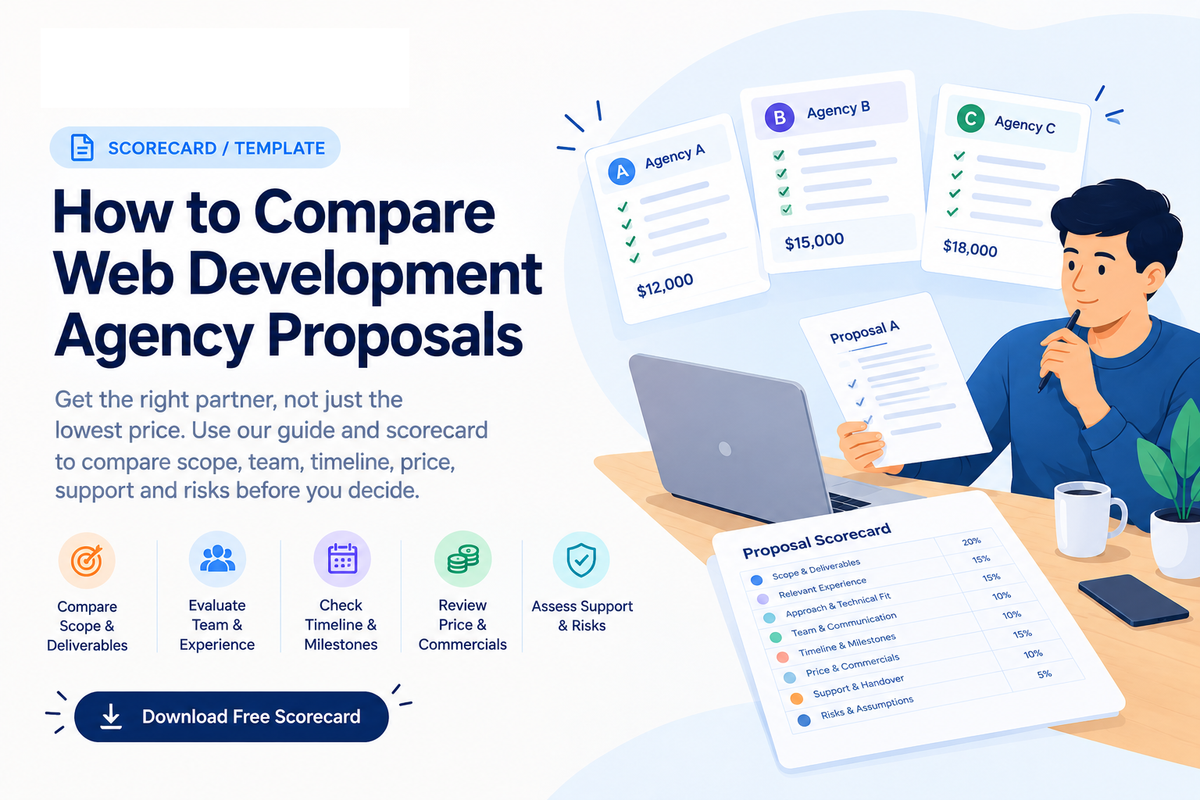
How to Compare Web Development Agency Proposals
Getting three agency proposals can sound like a good way to compare prices.
But there is a problem: agencies don't always quote the same thing.
One proposal may include design, SEO, testing and support. Another may only include development. One agency may recommend a custom solution while another suggests an existing platform.
So don't compare only the final price.
Compare what you are actually getting.
1. Start with the scope
Check whether every agency understood the same project.
Compare:
- Pages and screens
- Features and workflows
- Integrations
- Admin functionality
- Content migration
- SEO requirements
- Testing and launch
Also look for exclusions. Missing items can become additional costs later.
2. Look at the proposed team
Ask who will actually work on your project.
Check the:
- Project manager
- UI/UX designer
- Developers
- QA / testing team
- Technical lead, if needed
You should know which people are assigned to your project rather than only seeing the agency's overall team size.
3. Compare the approach, not just the technology
Two agencies may recommend different technologies and both may have reasonable reasons.
Look for the explanation behind the recommendation:
- Why this approach?
- How will it scale?
- How will it be maintained?
- What are the main risks?
- What alternatives were considered?
A clear explanation is more useful than a long list of technical terms.
4. Check the timeline
Compare:
- Estimated duration
- Milestones
- Client responsibilities
- Approval process
- Testing period
- Launch plan
An "8-week project" doesn't tell you much if you don't know what happens during those eight weeks.
5. Compare the price properly
Don't compare only the final number.
Check whether the proposal includes:
- Design
- Development
- Testing
- Deployment
- Content migration
- Third-party integrations
- Hosting or licenses
- Post-launch support
Ask each agency to clearly identify additional costs, assumptions and exclusions.
6. Read the support and handover terms
Find out what happens after launch.
Look for:
- Bug-fix period
- Maintenance options
- Response times
- Documentation
- Source-code ownership
- Credentials
- Asset handover
A project isn't necessarily finished just because the website is live.
7. Look for risks and assumptions
A useful proposal should tell you what could affect the project.
Pay attention to:
- Missing information
- Dependencies
- Unclear integrations
- Content delays
- Approval requirements
- Features requiring further discovery
This can tell you a lot about how carefully an agency has reviewed your project.
Before making a decision
Don't select an agency from the proposal alone.
Shortlist the proposals that fit your requirements, then ask the same follow-up questions and speak with the proposed team.
The goal is simple:
Understand exactly what you're buying, what isn't included, and what happens if the project changes.